
Introduction
The online marketplace industry has revolutionized how businesses match buyers with sellers. With a wide range of options, from ecommerce marketplaces and service platforms to B2B exchanges and niche marketplaces, there has never been a better time than now to capitalize on the internet marketplace trend and build your own successful business.
One of the most crucial choices when starting an online marketplace, however, could determine the success of your business in the coming years: whether to build and run your own platform or use a subscription-based one. On the surface, a subscription platform appears to be advantageous because of the low cost of setting up a website. Ownership platforms, although requiring significant initial investment, can be more flexible.
There comes a point when such aspects as cost-effectiveness, ability to scale, customization, data control and revenue generation become crucial and need to be considered. This article will discuss these and other aspects to determine which of the two options will yield more sustainable results.
What Is Marketplace Ownership?
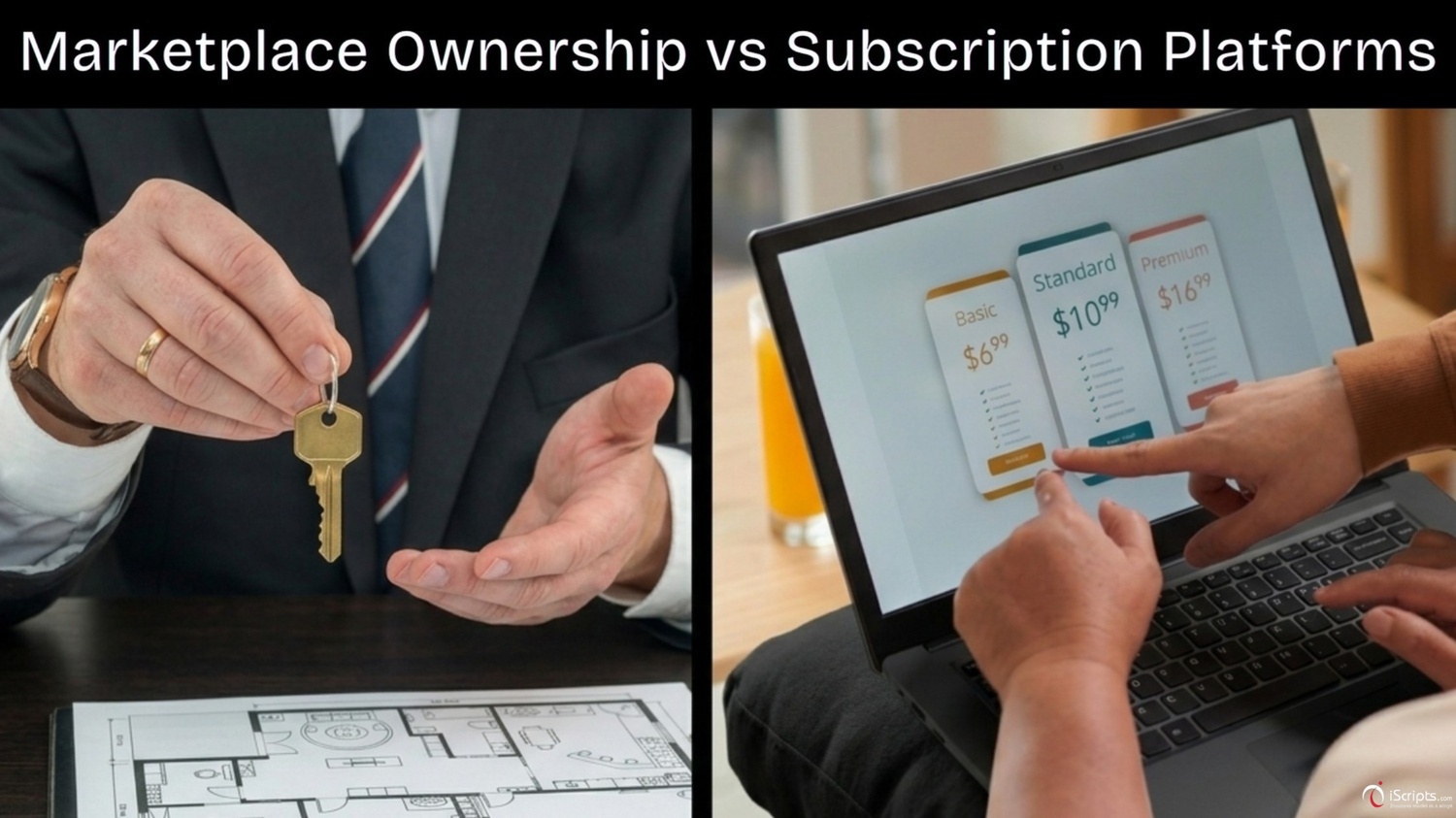
Marketplace ownership means managing your own marketplace through the use of software that you have bought or licensed yourself. In other words, with marketplace ownership, you will be in charge of your platform, its features, its infrastructure, and all aspects related to your business management.
Contrary to the software subscriptions, where you pay regularly to use software, with ownership, you can enjoy more freedom and flexibility.Marketplace ownership is often preferred by businesses that view their marketplace as a long-term asset rather than a temporary project.
Key Characteristics of Marketplace Ownership
- Total control of the platform’s functionalities
- Personalization of platform functionalities and workflows
- Ownership of the marketplace data
- Hosting flexibility for the platform
- No monthly or annual payments for using the platform
- Ease of scaling in the future
What are Subscription-Based Marketplace Platforms?
Subscription-based marketplace software is based on the SaaS concept where the businesses do not buy the software but rather make monthly or annual payments to be able to use it.
Hosting, maintenance, upgrades, and security are handled by the company providing the service while the clients use the software within certain parameters.The subscription-based platforms can be especially useful for new businesses that need a quick start.
Key Characteristics of Subscription Platforms
- Monthly or annual subscriptions
- Low technical management needs
- Quick set-up and implementation
- Maintenance and upgrades performed by the vendor
- Little possibility for customization
- Dependency on the platform provider
Why the Choice Matters for Long-Term Growth
Entrepreneurs tend to place high importance on speed of delivery when picking a marketplace platform. Although speed of delivery should be considered, there are other considerations that determine growth. A capacity for adaptability becomes vital because what suits a marketplace in its early stages may not suffice as the company grows. Some of the needs of growing marketplaces include:
- New revenue models
- More sophisticated seller management systems
- Unique workflows
- Integrations
- Improved user experience
- Improved performance and scalability
Comparing Marketplace Ownership and Subscription Platforms
| FACTOR | MARKETPLACE OWNERSHIP | SUBSCRIPTION PLATFORMS |
| Initial Cost | Higher upfront investment for software, hosting, and setup. | Lower startup cost with monthly or annual fees. |
| Long-Term Cost | Generally lower over time since there are no recurring platform fees. | Costs continue indefinitely and often increase as the business grows. |
| Control | Full control over platform features, policies, and business operations. | Limited control; the platform provider determines many aspects of functionality and policies. |
| Customization | Extensive customization options to meet unique business needs. | Usually limited to predefined themes, templates, and settings. |
| Scalability | Flexible infrastructure that can be expanded as traffic and transactions increase. | Scalability depends on provider plans and may involve higher subscription costs. |
| Data Ownership | Complete ownership and access to customer, seller, and transaction data. | Data access may be restricted by provider policies and subscription levels. |
| Revenue Flexibility | Freedom to implement multiple monetization models and revenue streams. | Revenue options may be limited by platform capabilities and transaction fee structures. |
| Third-Party Integrations | Can integrate virtually any compatible tool or service. | Integration options are often limited to those supported by the provider. |
| Vendor Dependency | Independent operation with no reliance on a specific software vendor. | Dependent on the provider for updates, pricing, support, and feature availability. |
| Brand Differentiation | Easier to create a unique marketplace experience and brand identity. | Similar design and functionality may be shared with many other marketplaces. |
| Maintenance Responsibility | Business owner manages hosting, updates, and technical maintenance (or outsources it). | Provider handles maintenance, security updates, and infrastructure management. |
| Best For | Businesses focused on long-term growth, scalability, and complete control. | Startups seeking a quick launch with minimal technical management. |
Situations Where Marketplace Ownership Is the Better Choice
Businesses expecting significant growth would prefer to own their marketplace. Ownership of the marketplace would be more appropriate where there is:
- Long term viability of the market place envisaged
- The need for customization of services required
- Scalability of the business considered important
- Ownership of data considered crucial
- Multiple income sources expected
- Need for business independence
Marketplace Ownership vs Subscription Platforms
Situations Where Subscription Platforms Make Sense
Even with their drawbacks, subscription platforms may prove to be quite an appropriate option in some cases. Subscription platforms are especially appropriate when:
- Validating a startup idea
- Short on technical know-how
- Quick implementation is crucial
- Project time horizon is short
The Hidden Risks of Subscription Platforms
The risks associated with subscription platforms are often underestimated by many entrepreneurs. While these risks may go unnoticed during the startup period, they will likely emerge later as the market grows. These risks may include the following:
- Vendor Lock-In: It might be hard, costly, and time-consuming to switch to other channels.
- Rising Costs: As businesses grow, their subscription prices are likely to rise.
- Feature Limitations: Companies might not be able to utilize certain innovations because of these limitations.
- Influence of Third Parties: Changes to the platform’s terms and conditions can affect a company’s performance.
Which Option Is Better for Growth?
The solution, in large part, rests upon the objectives of your company. For those seeking rapid development with low initial costs, a subscription-based model may work well.
But for businesses whose objective is developing a sustainable business based on a marketplace where they have total control over all elements of the operation, then ownership of the platform is probably better. A business must be agile, able to change direction rapidly, and be independent.
Conclusion
The choice between marketplace ownership and subscription platforms goes beyond just choosing one software platform. This is a business strategy, which could affect many areas, such as profits, scalability, and overall success. While subscription platforms bring convenience and affordability at the beginning of the process, ongoing fees, lack of customization options, and dependence on third parties could make things more difficult further down the road.
The disadvantages of marketplace ownership are obvious; it involves a considerable initial investment. Yet its pros outweigh the cons, making marketplace ownership an ideal solution for many reasons. Entrepreneurs committed to their business’s long-term development should focus on creating valuable property.