
Today, many usable products are thrown away or replaced even though they still have value. As people become more aware of waste and environmental issues, they are looking for smarter ways to use resources and reduce unnecessary consumption. This growing focus on sustainability has brought renewed interest in bartering, where people exchange goods and services instead of relying only on money.
Bartering is no longer just for small-scale local transactions. Barter systems are being used by people, groups, and companies to exchange things they no longer need for things they can utilize. Barter systems help preserve valuable products in circulation and minimize waste for everything from equipment and other commodities to household goods and collectibles.
This trend has also been influenced by the popularity of thrift culture, particularly among Gen Z. When it’s feasible, more individuals are opting to purchase reused and used goods rather than brand-new ones. Prolonging product life and lowering landfill trash, this promotes a more sustainable way of living in addition to saving money.
Managing listings, users, and transactions by hand can get challenging as barter groups expand. By offering a single platform where users can display goods, communicate with traders, oversee trades, and monitor transactions, barter software streamlines the process. Selecting the appropriate barter software may enhance trading, promote community development, and guarantee efficient daily operations.
What Is Barter Software?
Barter software is a platform that helps individuals, communities, and organizations manage the exchange of goods and services without relying entirely on cash transactions. It provides tools for listing items, connecting traders, tracking exchanges, managing user accounts, and maintaining transaction records.
Barter systems are made to enable direct transactions between users, in contrast to typical marketplaces that concentrate on buying and selling. While some systems allow one-to-one transactions, others employ points or credits to increase trading flexibility.
Barter exchanges, online trading communities, local exchange networks, associations, and companies that wish to establish an organized setting for the exchange of products and services frequently employ barter software.
Why Businesses and Organizations Use Barter Software
Managing transactions by hand can become challenging and time-consuming as barter networks expand. By offering a centralized platform where users may post things, communicate with other members, and effectively manage transactions, barter software helps streamline operations. Barter software offers several significant advantages, regardless of whether the platform is used by companies, groups, or trade communities.
- Streamlined Trade Management
By consolidating ads, member accounts, and transactions into one location, barter software facilitates exchange management. With a single system, managers can monitor all trading activity rather than depending on spreadsheets, emails, or manual recordkeeping.
- Increased Trading Opportunities
Members can find goods and services that meet their needs with the aid of a well-run barter platform. The program helps consumers get more value out of the things they no longer need and promotes more exchanges by making listings visible and accessible.
- Reduced Administrative Workload
It can easily become too much to handle member registrations, approvals, listings, and transactions by hand. Many of these activities are automated by barter software, which saves time and lowers the possibility of mistakes.
- Better Transaction Tracking and Reporting
Any barter network must maintain accurate records. Barter software helps administrators keep an eye on platform activity and uphold openness by offering comprehensive transaction history, account information, and reporting capabilities.
- Improved Member Engagement and Retention
Members are encouraged to participate more actively when a barter platform is easy to use. Long-term community engagement and activity are facilitated by features like trade histories, messaging, notifications, and customized dashboards.
Essential Features to Look for in Barter Software
Not every barter software platform has the same features. Selecting a system with the functionality required to efficiently manage trades, users, and transactions is crucial to guaranteeing a seamless experience for administrators and members alike.
1. Member Management
A good barter platform should make it easy for users to join and participate in the community. Look for features that simplify registration, profile creation, and member administration.
Key features include:
- Easy member registration and onboarding
- User profile management
- Member approval and verification options
- Account status management
2. Trade Account Management
If your platform uses trade credits or points, the software should provide tools to manage user balances and transaction records accurately.
Look for:
- Trade credit or point tracking
- Account balance monitoring
- Transaction history for members
- Credit limits and account controls
3. Marketplace and Listing Management
The marketplace is the heart of any barter platform. Members should be able to easily list, discover, and exchange products or services.
Important features include:
- Product and service listings
- Search and filtering options
- Categories and subcategories
- Listing approval and moderation tools
4. Transaction Management
Managing exchanges efficiently is essential for maintaining trust within the community.
Useful features include:
- Automated transaction processing
- Trade approval and authorization tools
- Transaction records and history
- Invoice and receipt generation
5. Reporting and Analytics
Reporting tools help administrators understand platform activity and make informed decisions.
Look for software that offers:
- Transaction reports
- Member activity reports
- Trade volume tracking
- Custom reporting options
6. Communication Tools
Effective communication helps keep members engaged and informed about new opportunities.
Helpful features include:
- Internal messaging between members
- Email notifications
- Platform announcements and updates
- Alerts for new listings or trade requests
7. Mobile Accessibility
Many users prefer accessing platforms from their smartphones or tablets. Mobile-friendly software improves convenience and engagement.
Look for:
- Responsive design
- Mobile-friendly user interface
- Dedicated mobile apps, if available
8. Security and User Controls
Security is important for protecting user information and maintaining trust within the platform.
Key security features include:
- Secure user authentication
- Role-based permissions
- Data protection measures
- Activity logs and audit trails
By choosing barter software with these core features, you can create a more efficient, secure, and user-friendly trading environment for your community or organization.
Cloud-Based vs. Self-Hosted Barter Software
One of the most important decisions when choosing barter software is deciding whether to use a cloud-based solution or a self-hosted platform. Each option has its own advantages and limitations, and the right choice depends on your organization’s needs, budget, and technical resources.
Cloud-Based Barter Software
Cloud-based barter software is hosted and maintained by the software provider. Users can access the platform through a web browser without managing servers or technical infrastructure.
Benefits
- Quick and easy setup
- Lower upfront costs
- Automatic updates and maintenance
- Accessible from anywhere with an internet connection
- Reduced need for in-house technical expertise
Potential Limitations
- Less control over server infrastructure
- Ongoing subscription or recurring fees
- Customization options may be limited
- Dependence on the provider for updates and support
Self-Hosted Barter Software
Self-hosted barter software is installed on your own server or hosting environment. Your organization is responsible for managing the platform, updates, and security.
Benefits
- Greater control over data and system settings
- More flexibility for customization
- One-time licensing options may be available
- Ability to integrate with existing systems more easily
Potential Limitations
- Higher initial setup costs
- Requires technical knowledge or IT support
- Ongoing responsibility for maintenance and security
- Software updates must be managed internally
Which Option Is Best for Your Organization?
For businesses looking for a straightforward, low-maintenance solution with little technological needs, cloud-based barter software is frequently the best option. Instead of managing infrastructure, it lets administrators concentrate on expanding their barter community.
For businesses that require a lot of customization, more control over their data, or particular integration requirements, self-hosted barter software can be a better choice. It offers more flexibility and ownership, but it also calls for more technical expertise.
Think about things like your budget, technological resources, security requirements, customization needs, and long-term expansion objectives before choosing a choice. Your barter platform will continue to be effective and scalable as your community expands if you select the appropriate deployment model.
Questions to Ask Before Choosing a Barter Software Solution
With many barter software options available, it’s important to evaluate your requirements before making a decision. Asking the right questions can help you choose a platform that meets your current needs and supports future growth.
1. What Problems Are You Trying to Solve?
Start by identifying the challenges you want the software to address. Are you struggling with managing listings, tracking transactions, onboarding members, or handling administrative tasks? Understanding your pain points will help narrow down your options.
2. Who Will Use the Platform?
Consider your target users. Will the platform serve individuals, businesses, associations, local communities, or a combination of users? The answer can influence the features and user experience you need.
3. How Many Members Do You Expect to Have?
Choose software that can handle your current member base while also supporting future growth. A platform that works for 100 users today should still perform well if your community expands to thousands of members.
4. Do You Need a Product-Only or Product-and-Service Exchange Platform?
Some barter platforms focus mainly on physical goods, while others support both products and services. Make sure the software aligns with the type of exchanges your community will conduct.
5. Do You Require Trade Credits or Point-Based Trading?
If your platform plans to use trade credits, reward points, or virtual currency instead of direct item-for-item exchanges, verify that the software includes these capabilities.
6. How Easy Is the Software to Use?
A complicated platform can discourage participation. Look for software that offers a simple interface, easy navigation, and a smooth experience for both administrators and members.
7. What Customization Options Are Available?
Every barter community has unique requirements. Determine whether you can customize branding, workflows, member profiles, categories, and other platform features.
8. What Integrations Do You Need?
Consider whether the software needs to integrate with:
- Payment gateways
- Email marketing tools
- CRM systems
- Accounting software
- Social media platforms
- Mobile applications
9. Does the Software Offer Mobile Access?
Many users prefer trading from their smartphones. Check whether the platform is mobile-friendly or offers dedicated mobile apps.
10. What Security Features Are Included?
Since user information and transaction data are involved, security should be a priority. Look for features such as secure logins, role-based permissions, data encryption, and activity tracking.
11. How Are Listings and Transactions Managed?
Find out whether administrators can approve listings, monitor transactions, manage disputes, and moderate user activity when necessary.
12. What Reporting Tools Are Available?
Good reporting features can help you understand platform performance, member activity, transaction volume, and overall community engagement.
13. What Level of Customer Support Is Provided?
Ask what support options are available, including:
- Email support
- Live chat
- Phone assistance
- Training resources
- Documentation and knowledge bases
15. What Is the Total Cost of Ownership?
Look beyond the initial price. Consider setup fees, subscription costs, hosting expenses, maintenance charges, customization costs, and future upgrade requirements.
16. Can the Software Scale With Your Growth?
The platform you choose today should continue to meet your needs as your community expands. Consider future requirements, such as increased user base, additional features, and higher transaction volumes.
17. Is a Demo or Trial Available?
A product demonstration or free trial allows you to evaluate the software firsthand and determine whether it meets your expectations before making a commitment.
By answering these questions before selecting a solution, you’ll be better equipped to choose barter software that supports your goals, delivers a great user experience, and grows alongside your community.
Common Mistakes to Avoid When Selecting Barter Software
Choosing the right barter software requires more than comparing features and pricing. Avoiding the following mistakes can help you select a platform that supports your community’s long-term success.
- Choosing Based Solely on Price
- Not Clearly Defining Your Requirements
- Ignoring Scalability Requirements
- Overlooking User Experience
- Neglecting Security Considerations
- Not Testing the Software Before Purchase
- Underestimating Customization Needs
- Overlooking Integration Capabilities
- Ignoring Mobile Accessibility
- Failing to Evaluate Customer Support
- Not Reviewing Total Ownership Costs
- Choosing a Vendor Without a Proven Track Record
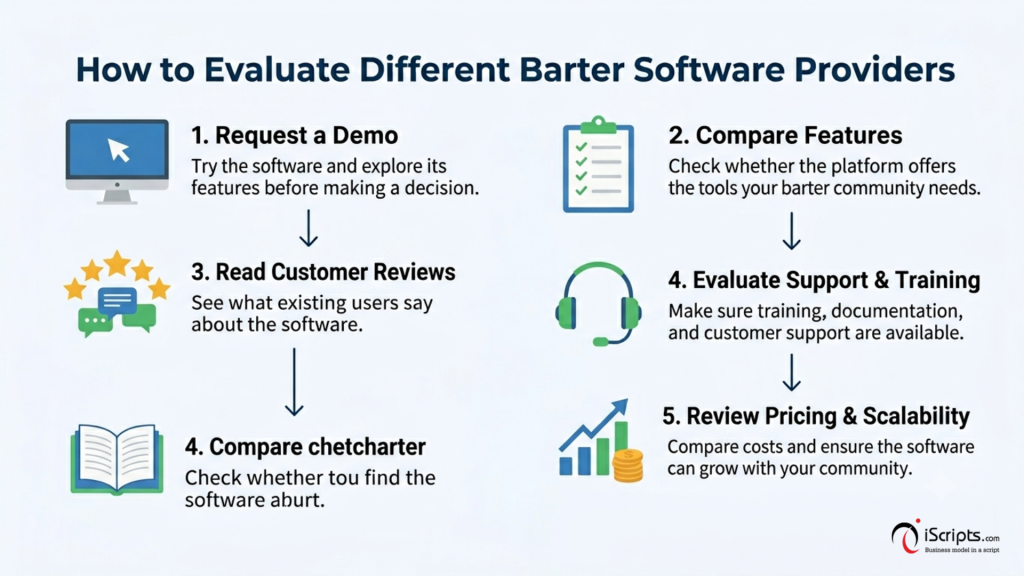
How to Evaluate Different Barter Software Providers
Choosing the right provider requires looking beyond pricing and feature lists. Before making a decision, take time to compare different solutions based on usability, support, scalability, and overall value. The following factors can help guide your evaluation process.
#image_title
By carefully evaluating providers using these criteria, you can identify a solution that meets your current needs while supporting future growth. Taking the time to compare options can help you avoid costly mistakes and choose software that delivers long-term value.
Signs You’ve Found the Right Barter Software
After evaluating different solutions, how do you know you’ve found the right barter software? The ideal platform should not only meet your current requirements but also provide a smooth experience for members and administrators alike. Here are some signs that you’ve made the right choice.
– Easy Member Adoption
A good barter platform should be simple and intuitive for users. If members can quickly create accounts, list items, search for opportunities, and complete trades without extensive training, the software is likely a good fit.
– Efficient Transaction Management
The right software makes it easy to manage exchanges, approvals, and transaction records. Administrators should be able to monitor activity without spending excessive time on manual tasks, while members should enjoy a smooth trading experience.
– Reliable Reporting and Analytics
Access to clear reports and performance insights is essential for managing a successful barter community. The software should provide accurate data on transactions, member activity, and overall platform performance, helping administrators make informed decisions.
– Strong Security Measures
Trust is a critical part of any barter network. Reliable software should include secure login systems, user permissions, data protection features, and activity tracking to safeguard both users and transactions.
– Scalable for Future Growth
Your barter platform should grow alongside your community. Whether you’re adding more members, listings, or new features, the software should continue to perform efficiently without requiring a complete system change.
– Active and Engaged Community
One of the clearest signs of effective barter software is strong member participation. When users regularly post listings, communicate with each other, and complete trades, it indicates that the platform is delivering value.
– Reduced Administrative Effort
If your team spends less time handling registrations, managing listings, tracking transactions, and resolving issues, the software is helping improve operational efficiency.
– Positive User Feedback
Member satisfaction is an important indicator of success. Positive feedback about ease of use, reliability, and overall experience suggests that the platform is meeting user expectations.
– Flexible and Customizable Features
The right solution should adapt to your organization’s needs rather than forcing you to change your processes. Customization options and flexible workflows are often signs of a well-designed platform.
– Dependable Support and Ongoing Updates
A reliable software provider will offer responsive customer support and regularly improve the platform with updates, security enhancements, and new features.
When a barter software solution delivers these benefits, it becomes more than just a tool – it becomes the foundation of a thriving and sustainable trading community.
Future Trends in Barter Software
As technology continues to evolve, barter software is becoming more advanced and user-friendly. Here are some trends that are likely to shape the future of barter platforms.
-> AI-Powered Trade Matching
Artificial intelligence can help users find better trading opportunities by recommending products, services, or members that match their interests and needs.
-> Better Analytics and Insights
Future barter platforms will offer more detailed reports and insights, helping administrators understand member activity, trading patterns, and platform growth more effectively.
-> Mobile-First Experiences
As more people use smartphones for online activities, barter software will continue to focus on mobile-friendly designs and improved mobile experiences.
-> Increased Automation
Automation can simplify many tasks, including member approvals, transaction processing, notifications, and reporting. This helps save time and improves efficiency.
-> More Integrations
Modern barter platforms are expected to integrate more easily with other business tools such as CRM systems, email marketing platforms, accounting software, and payment gateways.
Conclusion
The success of your barter community or organization can be greatly impacted by your choice of barter software. Before choosing a solution, there are a number of things to take into account, from security and scalability to member management and transaction tracking.
The best software is one that supports future expansion, meets your current needs, and aligns with your objectives. You may locate a platform that provides a seamless and effective trading experience by closely examining characteristics, posing pertinent queries, and avoiding typical blunders.
Purchasing the appropriate barter software now can contribute to the development of a barter network that is more structured, interesting, and long-lasting.
The right barter software can simplify trade management, improve member engagement, and help your platform scale with ease. Whether you’re building a local trading network, an online barter marketplace, or a business exchange community, choosing the right solution is the first step toward long-term success.
Ready to turn your barter marketplace idea into reality? Explore eSwap today and discover how easy it can be to build, manage, and grow a thriving barter network.
Trade What You Have, Get What You Need.

