

Digital consumers have fundamentally changed how they shop. Before making a purchase decision, users actively search for discounts, coupon codes, cashback offers, and limited-time promotions. This shift has created a powerful opportunity for entrepreneurs: the online deals website model.
An online deals website is not just a coupon listing page. When structured properly, it becomes a high-intent traffic engine that monetizes through affiliate commissions, advertising, sponsored placements, and data-driven partnerships.
This guide explains:
-
Why online deals websites matter in today’s digital economy
-
How they generate revenue
-
What determines long-term sustainability
-
How to build a scalable deals platform
The Growing Demand for Online Deals and Coupon Platforms
Search behavior clearly shows consistent demand for:
-
Promo codes
-
Discount offers
-
Flash sales
-
Seasonal deals
-
Local service discounts
Consumers are increasingly price conscious, especially in competitive ecommerce categories. Before checkout, many users open a new browser tab to search for a coupon code. Deals websites position themselves directly in that decision moment.
This creates a powerful acquisition advantage: users arrive with buying intent.
Unlike general content websites, a deals platform captures users who are already prepared to transact.
What Is an Online Deals Website?
An online deals website is a digital platform that aggregates and promotes:
-
Coupon codes
-
Discount offers
-
Limited-time promotions
-
Cashback incentives
-
Merchant campaigns
The platform acts as an intermediary between merchants and consumers. It does not hold inventory. It does not manage fulfillment. Instead, it monetizes traffic and transaction referrals.
This makes it structurally different from traditional ecommerce businesses.
How Online Deals Websites Generate Revenue
A scalable online deals website typically uses multiple monetization channels.
1. Affiliate Commission Model
The most common revenue model is affiliate marketing.
When users click a deal and complete a purchase on a merchant’s website, the deals platform earns a percentage commission.
Advantages:
-
No inventory risk
-
Performance-based revenue
-
Highly scalable
Limitations:
-
Dependent on merchant partnerships
-
Commission rate fluctuations
The profitability of this model depends on traffic quality and conversion rate optimization.
2. Sponsored Listings and Featured Deals
Merchants may pay for:
-
Homepage placement
-
Category highlighting
-
Featured deal promotion
-
Email campaign inclusion
This advertising based revenue often delivers high margins because it requires minimal additional cost.
However, sponsored placements require strong traffic metrics to justify pricing.
3. Subscription or Premium Access
Some online deals websites introduce a membership layer offering:
-
Exclusive discounts
-
Early access to promotions
-
Higher cashback rates
This introduces recurring revenue and improves forecasting stability.
The challenge lies in delivering differentiated value that justifies subscription fees.
4. Lead Generation and Data Monetization
A deals platform can collect user preferences, behavior insights, and purchasing intent data. With appropriate compliance and privacy safeguards, this data can be used for:
-
Targeted marketing
-
Merchant insights
-
Campaign optimization
Data-driven monetization strengthens long-term defensibility.
Strategic Advantages of Launching an Online Deals Website
When structured properly, this business model offers several economic benefits.
1. High Intent Traffic
Users searching for deals are typically in purchase mode. This leads to stronger conversion rates compared to general browsing traffic.
2. Asset-Light Structure
Unlike ecommerce stores, deals websites do not:
-
Purchase inventory
-
Manage warehousing
-
Handle shipping logistics
This reduces capital requirements and operational complexity.
3. Scalability
Revenue increases as traffic increases. Infrastructure costs do not scale linearly with transaction volume, creating potential operating leverage.
4. Multi-Niche Expansion
A deals platform can expand into:
-
Retail ecommerce
-
Travel and hospitality
-
Software subscriptions
-
Local services
-
Food and dining
This diversification reduces dependency on a single vertical.
Challenges and Risks of Online Deals Platforms
Despite its advantages, the model requires disciplined execution.
SEO and Traffic Dependency
Organic search often drives the majority of traffic. Algorithm changes can impact visibility and revenue.
Diversifying acquisition channels through email marketing, social platforms, and partnerships is critical.
Merchant Relationship Management
Affiliate agreements, commission structures, and tracking reliability must be maintained carefully.
Weak partnerships reduce revenue potential.
User Trust and Fraud Prevention
Expired coupons, misleading promotions, or low-quality offers damage credibility. Trust is a long-term asset in the deals ecosystem.
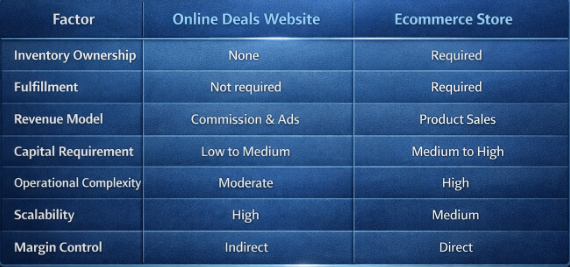
Online Deals Website vs Ecommerce Store
Technology Requirements for a Scalable Deals Website
To compete effectively, a modern online deals platform should support:
-
Automated coupon management
-
Expiry tracking
-
Affiliate link integration
-
Merchant dashboards
-
Category filtering and search
-
User reviews and ratings
-
Mobile responsive design
-
Analytics and reporting
Automation reduces administrative overhead and improves scalability.
Manual deal tracking quickly becomes inefficient as volume grows.
Who Should Launch an Online Deals Website?
This model is particularly suitable for:
-
SEO-focused entrepreneurs
-
Affiliate marketers
-
Content publishers
-
Media businesses
-
Local market aggregators
-
Digital marketers with traffic expertise
It is less ideal for founders without marketing capability, since traffic acquisition drives revenue.
Long Term Sustainability Factors
An online deals website becomes a durable digital asset when it achieves:
-
Diversified traffic sources
-
Strong merchant partnerships
-
High repeat user engagement
-
Email list growth
-
Data-driven optimization
The difference between short-term affiliate income and long-term platform value lies in structure and systems.
Building a Scalable Online Deals Platform
Launching from scratch requires:
-
Backend development
-
Merchant onboarding systems
-
Coupon tracking automation
-
User management features
-
Reporting dashboards
-
Monetization integration
Using ready-to-deploy solutions significantly reduces time to market.
iScripts provides customizable and scalable software solutions for building online deals and coupon websites. Entrepreneurs can launch faster with built-in features for deal management, merchant integration, and user engagement—allowing them to focus on traffic acquisition and strategic growth instead of technical development.
Traffic Is the Engine, Structure Is the Advantage
Online deals websites succeed when they combine: High-intent traffic, Reliable affiliate partnerships, Scalable infrastructure, Trust based user experience
The opportunity is not simply listing coupons. The opportunity is structuring a digital platform that converts purchase intent into recurring commission revenue. With the right technology foundation and disciplined execution, an online deals website can evolve into a scalable, traffic-driven digital asset with long-term revenue potential.
To successfully launch and scale a high-performing online deals platform, the right technology foundation is essential. This is where iScripts MultiCart becomes a strategic advantage. Built specifically for multi-vendor marketplaces and eCommerce ecosystems, iScripts MultiCart provides robust vendor management, commission control, deal-based pricing, payment integrations, marketing tools, and full administrative oversight all within a scalable architecture. Instead of spending months building complex marketplace functionality from scratch, entrepreneurs can leverage a proven framework designed for growth, customization, and operational efficiency. Many growing brands eventually explore how to turn your store into an online multi-vendor marketplace as a way to expand product variety without increasing inventory risk. For businesses aiming to build a profitable, scalable online deals website, iScripts MultiCart offers the infrastructure needed to move from concept to revenue with confidence.

