
Investing in web and mobile applications is a strategic move for businesses seeking growth, operational efficiency, and a competitive edge. However, the stakes are high: poor planning, unclear requirements, or the wrong technology choice can result in wasted time, budget overruns, and missed market opportunities.
This guide provides business leaders with actionable insights on planning, budgeting, development strategies, tools, testing, and post-launch success.
1. Understanding Web & Mobile App Development
Web and mobile app development is more than just coding. It encompasses designing, building, and deploying applications that provide seamless user experiences across devices. Modern development emphasizes:
-
Cloud Integration: Applications leverage cloud infrastructure to scale on demand and reduce hosting costs.
-
AI & Machine Learning: Personalized recommendations, predictive analytics, and process automation.
-
Low-code/No-code Platforms: Accelerates prototyping and MVP launches without compromising quality.
-
Cross-platform Development: Single codebase for multiple platforms reduces development time and cost.
Current Business Trends:
-
AI-powered features drive customer personalization and efficiency.
-
Cloud-native architectures enable fast scaling without heavy infrastructure investment.
-
Low-code tools allow teams to validate ideas quickly, reducing time-to-market.
-
Progressive Web Apps (PWAs) deliver app-like experiences on web browsers, expanding reach without full mobile app investment.
Decision makers should focus on technologies that maximize ROI, scalability, and user adoption.
2. Validating Your App Idea
A validated app idea reduces risk and ensures that resources are invested in features that solve real business problems.
Validation Checklist for Business Leaders:
-
Market Research: Analyze industry trends, competitor offerings, and target audience pain points.
-
Define the MVP: Prioritize core features that deliver the highest value.
-
Prototype Development: Build a clickable prototype or wireframe to gather early feedback.
-
Cost vs Benefit Analysis: Estimate development and operational costs against projected revenue or operational efficiency gains.
-
Pilot Testing: Launch the MVP to a controlled audience segment, measure engagement, and iterate.
Tools for validation include SurveyMonkey, Figma, Hotjar, Typeform, and Trello.
Following a structured validation process ensures a higher chance of market fit and investor confidence.
3. Budgeting and Cost Considerations
Understanding development costs upfront helps businesses plan budgets, timelines, and ROI expectations. Costs vary by platform, complexity, and region.
Estimated Cost Ranges (USD):
-
Simple Web App: 10,000–30,000
-
Complex Web App: 30,000–100,000
-
Native Mobile App: 25,000–80,000
-
Cross-platform Mobile App: 20,000–70,000
Budget Planning Considerations:
-
UI/UX Design: Critical for adoption and retention.
-
Backend Development: Includes servers, databases, and APIs.
-
Security & Compliance: Data protection, privacy regulations, and authentication.
-
Maintenance & Updates: Bug fixes, feature enhancements, and platform upgrades.
-
Testing & QA: Ensures reliability before launch.
-
Marketing & Analytics: App promotion, user acquisition, and performance tracking.
Decision makers should consider total cost of ownership and long-term scalability rather than only initial development cost.
4. Choosing the Right Tools & Frameworks
Selecting the proper framework influences development speed, cost, and application performance.
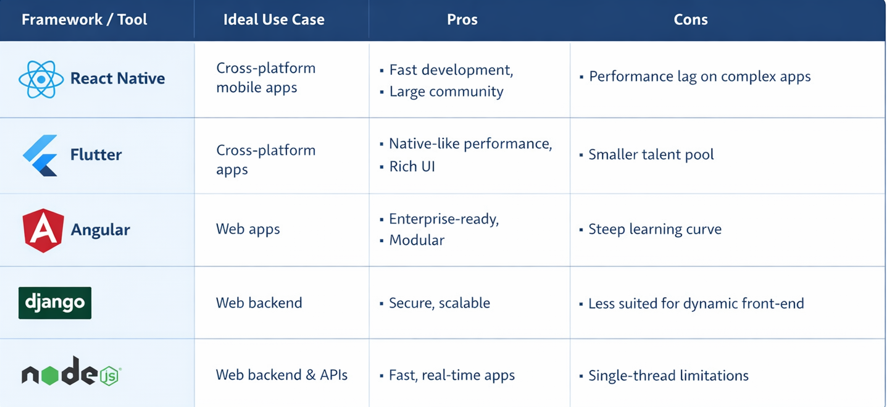
Business leaders should select a stack based on team expertise, scalability needs, and long-term maintenance costs.
5. Testing Strategies
Robust testing ensures that your app meets quality standards, maintains user trust, and avoids costly post-launch fixes.
Manual Testing:
-
Evaluates UI/UX and user workflows.
-
Cost-effective for exploratory testing but slower.
Automated Testing:
-
Best for regression, repetitive tasks, and large-scale testing.
-
Higher upfront cost but faster and more reliable for repeated test cycles.
Testing Checklist for Decision Makers:
-
Identify critical workflows that require automation.
-
Allocate manual testing for UI/UX and edge cases.
-
Use tools like Selenium, Appium, or Cypress for automation.
-
Track defects, monitor resolutions, and iterate before launch.
A combination of manual and automated testing provides quality assurance without inflating costs.
6. Ensuring Post-Launch Success
Launching an app is only the first step. Post-launch strategy determines adoption, retention, and long-term ROI.
Steps for Post-Launch Success:
-
Monitor KPIs: Track user retention, engagement, conversion rates, and revenue metrics.
-
Feedback Loop: Collect user input and prioritize updates based on real needs.
-
Iterative Updates: Plan incremental improvements for features, performance, and security.
-
Marketing & Promotion: Drive adoption through targeted campaigns aligned with user behavior.
-
Analytics: Implement tools like Google Analytics, Firebase, or Mixpanel to measure performance.
A structured post-launch approach ensures sustained growth and measurable business impact.
Drive Your App Success with iScripts
Building a web or mobile app is more than just development it’s a strategic investment that can transform customer experiences, streamline operations, and generate measurable ROI. Success requires careful planning, validated ideas, smart budgeting, the right technology stack, rigorous testing, and a structured post-launch strategy.
With the right approach, businesses can minimize risk, accelerate time-to-market, and maximize the impact of their digital products.
iScripts helps companies turn ideas into reality with end-to-end development expertise, modern frameworks, and scalable solutions tailored to your business goals. From ideation and MVP creation to testing and post-launch support, iScripts ensures your app is built to succeed.

