
Security Is No Longer Optional. It’s a Business Requirement. Every hosting platform today operates in an environment where data breaches, regulatory scrutiny, and customer expectations are constantly increasing. For businesses running or planning to launch a hosting platform, security and compliance are not just technical concerns. They directly impact customer trust, legal risk, and long term scalability.
A single vulnerability can lead to financial loss, reputational damage, and regulatory penalties.
Understanding how to design a secure and compliant hosting platform is critical for sustainable growth.
What Is Security and Compliance in Hosting Platforms
Security refers to the measures taken to protect systems, data, and infrastructure from unauthorized access and threats.
Compliance refers to adhering to legal, regulatory, and industry standards governing data protection and operations.
Security protects hosting platforms from threats, while compliance ensures adherence to legal and regulatory standards for data protection.
Why Security and Compliance Matter for Hosting Businesses
1. Customer Trust and Retention
Businesses and users expect their data to be secure. Security incidents reduce trust and increase churn.
2. Legal and Financial Risk
Non-compliance can lead to heavy fines and legal action.
3. Competitive Advantage
Secure platforms are more attractive to enterprise customers.
4. Business Continuity
Strong security reduces downtime and operational disruptions.
Security and compliance directly impact trust, revenue, and long term business sustainability in hosting platforms.
Key Security Components Every Hosting Platform Must Have
1. Data Encryption
- Encrypt data at rest and in transit
- Use SSL certificates for secure communication
2. Access Control
- Role based access management
- Multi-factor authentication
3. Network Security
- Firewalls and intrusion detection systems
- DDoS protection
4. Backup and Recovery
- Regular automated backups
- Disaster recovery plans
5. Monitoring and Threat Detection
- Real time monitoring
- Automated alerts for suspicious activity
Major Compliance Standards You Should Know
General Data Protection Regulation
- Applies to businesses handling EU user data
- Focuses on data privacy and user consent
ISO/IEC 27001
- International standard for information security management
- Demonstrates strong security practices
Payment Card Industry Data Security Standard
- Required for handling payment information
- Ensures secure payment processing
Health Insurance Portability and Accountability Act
- Applies to healthcare related data
- Focuses on patient data protection
Common Security Risks in Hosting Platforms
Data breaches
Unauthorized access to sensitive data
DDoS attacks
Overloading servers to disrupt services
Malware infections
Compromising systems and user data
Insider threats
Misuse of access by internal users
Misconfigurations
Incorrect setup leading to vulnerabilities
Security vs Compliance: What’s the Difference
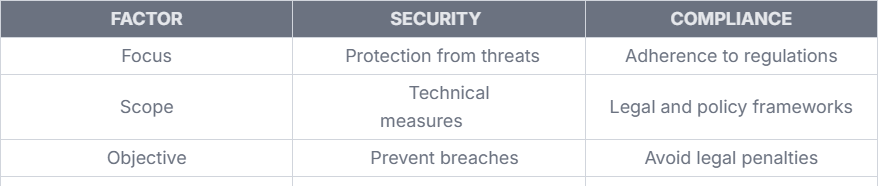
Security focuses on protection, while compliance ensures adherence to regulations. Both are essential for hosting platforms.
Best Practices for Building a Secure Hosting Platform
Implement layered security
Use multiple security controls instead of relying on a single solution
Automate security processes
Automate updates, monitoring, and backups
Regular audits and testing
Conduct vulnerability assessments and penetration testing
Ensure compliance from the start
Design systems with regulatory requirements in mind
Train teams and users
Human error is a major cause of security incidents
The Cost of Ignoring Security and Compliance
Ignoring security leads to:
- Financial losses from breaches
- Legal penalties from non-compliance
- Loss of customer trust
- Long term damage to brand reputation
For decision-makers, investing in security early is significantly more cost effective than reacting to incidents later.
The Role of Automation in Hosting Security
Automation plays a critical role in maintaining security at scale.
It helps:
- Detect threats in real time
- Reduce manual errors
- Ensure consistent compliance
- Improve response time to incidents
Automation improves hosting security by enabling real time monitoring, faster response, and reduced human error.
Security as a Growth Enabler, Not a Cost Center
Modern businesses are shifting perspective. Security is no longer just about protection. It is about enabling growth.
Secure platforms:
- Attract enterprise clients
- Enable global expansion
- Support long term scalability
Building Secure and Compliant Hosting Platforms at Scale
Security and compliance are foundational to any successful hosting business. They protect users, reduce risk, and enable long term growth.
However, implementing these systems manually can be complex and resource intensive. Businesses need platforms that integrate security features, automate critical processes, and support compliance requirements without adding operational overhead.
Solutions like iScripts AutoHoster provide built in automation for hosting management, billing, and user control, allowing businesses to create structured and scalable hosting environments. This makes it easier to incorporate security best practices and maintain compliance while focusing on growth and customer experience.
FAQs
What is security in hosting platforms?
What is compliance in hosting?
Why is compliance important for hosting businesses?
What are common security threats in hosting platforms?
How can hosting platforms improve security?
