
Last mile delivery has become one of the most important competitive battlegrounds for logistics companies. As ecommerce volumes rise and customers expect faster delivery timelines, the pressure on last mile operations has increased significantly. The challenge is that last mile delivery is also the most expensive and unpredictable segment of the supply chain. It involves real world variables such as traffic, driver behavior, parcel density, travel distance, and customer availability.
For decision makers, improving last mile efficiency is no longer a nice addition. It is a business priority directly tied to profitability, customer satisfaction, and long term operational scalability.
Last Mile Delivery: Why Efficiency Matters More Than Ever
The explosion of ecommerce has transformed last mile logistics. Consumers not only demand fast delivery, they also expect predictable timing, real time updates, and flexible delivery options.
The challenge is that the last mile accounts for the largest share of total logistics cost. Even small inefficiencies quickly multiply across thousands of daily deliveries.
Modern delivery companies therefore need deeper visibility into operations, adaptive routing, smart driver allocation, and automated communication with customers. Without this, the delivery network becomes slow, expensive, and nearly impossible to scale.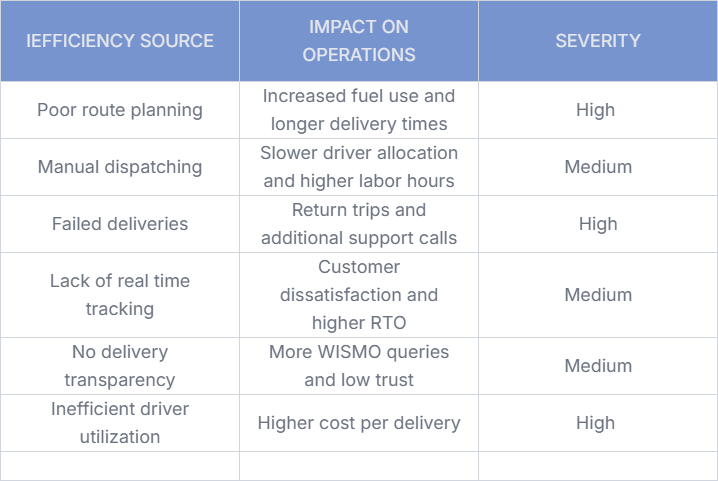
3. The Impact of Efficiency on Delivery Profitability
Efficiency is not just an operational goal in last mile logistics. It directly determines how profitable each delivery can be. Since last mile deliveries already account for up to 53 percent of total logistics cost, even small improvements in routing, workforce allocation, and delivery accuracy generate significant financial gains. Below is an expanded breakdown showing how efficiency influences the core levers of delivery profitability.
Cost Per Delivery
Last mile inefficiencies inflate cost per delivery more than any other factor. Common cost drivers include excess fuel consumption, long travel distances, manual dispatching, and repeated delivery attempts.
Impact of higher efficiency:
Reduced fuel and vehicle maintenance through optimized routing
Lower labor hours due to automated planning
Fewer failed deliveries, which can reduce return trips by up to 20 percent
Higher route density, making each trip more cost effective
Industry insight:
Companies that adopt automated routing typically reduce cost per delivery by 10 to 25 percent within months.
Driver Productivity
Driver productivity determines throughput. When drivers follow inefficient routes or receive unclear instructions, delivery capacity drops and cost per order climbs.
Efficiency improvements lead to:
More deliveries per driver per shift
Less idle driving between stops
Faster navigation with real time adjustments
Reduced time spent searching for addresses or customer locations
A highly optimized last mile setup can increase driver output by 15 to 30 percent without adding more vehicles or staff.
Customer Satisfaction Scores
Customers judge delivery performance primarily on timeliness, accuracy, and communication. Inefficiencies cause delays, missed delivery attempts, and lack of predictability, all of which reduce customer satisfaction.
Effects of higher efficiency on customer experience:
More accurate delivery windows
Real time tracking reduces WISMO (“Where is my order”) queries
Lower failure rates lead to fewer disputes
Proactive notifications build transparency and trust
Higher efficiency consistently pushes satisfaction scores up by 20 percent or more, especially for recurring ecommerce deliveries.
Operational Scalability
Many delivery companies fail to scale because their operations depend too heavily on manual processes. As order volume grows, the inefficiencies multiply.
Efficiency enables scalable systems by:
Automating repetitive tasks like dispatching
Centralizing real time visibility for operations teams
Optimizing driver allocation, even during peak seasons
Reducing the need to hire proportional labor as order volume increases
Efficient companies deliver more orders without increasing administrative overhead.
Brand Reputation
In delivery services, reliability becomes part of the brand identity. Customers have long memories when it comes to missed or late deliveries.
Efficiency strengthens brand reputation by:
Consistent on time delivery rates
Fewer complaints and escalations
Higher likelihood of customers recommending the service
Better partner and merchant trust
Efficient companies develop a reputation for predictability, which becomes a competitive advantage.
Ability to Compete with Major Delivery Players
Large delivery companies like Amazon, FedEx, and hyperlocal players excel because of their extreme focus on last mile efficiency. Smaller and mid market logistics providers can only compete if they close the efficiency gap.
Efficiency gives mid sized companies the ability to:
Match fast delivery expectations
Offer competitive delivery pricing
Handle peak season spikes without breaking
Deliver consistent quality at scale
By optimizing last mile operations, companies reduce their dependence on price competition and instead compete on reliability.
What Contributes Most to Last Mile Costs
Understanding cost distribution helps identify where improvements will have the highest impact.
Cost Distribution in Last Mile Delivery
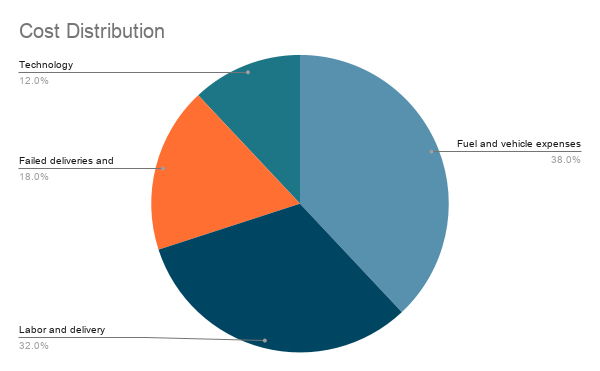
- Fuel and vehicle expenses: 38 percent
- Labor and delivery workforce: 32 percent
- Failed deliveries and returns: 18 percent
- Technology and infrastructure: 12 percent
This shows that fuel and labor are the largest cost drivers, making route optimization and workforce efficiency critical. Failed deliveries also add significant hidden costs through repeat attempts and customer dissatisfaction.
Key Strategies to Improve Last Mile Delivery Efficiency
Route Optimization and Smart Dispatching
Route optimization reduces travel distance and delivery time by calculating the most efficient paths. Smart dispatching assigns deliveries based on driver location and availability.
This improves fuel efficiency, reduces delays, and increases driver productivity.
Real Time Tracking and Delivery Visibility
Real time tracking provides visibility into delivery progress for both businesses and customers. It reduces uncertainty and enables proactive issue resolution.
This leads to better customer experience and fewer support queries.
Automated Workflow Management
Automation replaces manual processes such as order assignment and status updates. It ensures consistency and reduces errors.
This improves operational speed and reduces administrative workload.
Reducing Failed Deliveries
Failed deliveries increase cost and reduce efficiency. They are often caused by poor communication or incorrect information.
Solutions include delivery notifications, flexible scheduling, and address verification.
Data Driven Performance Monitoring
Tracking key performance metrics helps identify inefficiencies and improve decision making.
Important metrics include cost per delivery, delivery success rate, and driver utilization.
Customer Communication Automation
Automated notifications keep customers informed throughout the delivery process. This reduces uncertainty and improves satisfaction.
How Technology Drives Last Mile Efficiency
Technology enables companies to manage delivery operations more effectively. Modern logistics platforms combine routing, tracking, dispatching, and analytics into one system.
This provides better control, faster decision making, and improved scalability.
Last mile delivery efficiency is directly linked to profitability, customer satisfaction, and operational scalability. Companies that adopt optimized routing, automation, and real time tracking consistently achieve better results.
As delivery volumes grow, manual processes become inefficient and difficult to manage. Businesses need systems that simplify operations while maintaining speed and accuracy.
Solutions like iScripts Logistics provide a unified platform for managing routing, dispatching, tracking, and delivery workflows. This enables companies to improve efficiency without building complex systems internally and helps them scale operations with confidence.
FAQs
What is last mile delivery efficiency?
How can companies reduce last mile delivery costs?
Why is route optimization important?
How does real time tracking help?
What causes failed deliveries?
