

Customer expectations have shifted permanently. Response time is no longer measured in days. It is measured in minutes. As businesses grow across regions, products, and channels, customer queries increase in volume and complexity. Without structure, the response quality declines, resolution slows, and customer churn rises.
For decision makers, managing customer queries at scale is an operational efficiency and revenue priority. Structured systems, automation, and measurable processes are what separate scalable organizations from reactive ones.
Below is how growing businesses build scalable customer query management frameworks.
1. Centralizing All Support Channels
Customers engage through multiple channels including email, live chat, web forms, social platforms, and phone. Managing these channels independently creates fragmented conversations and lost context.
Scalable organizations consolidate all incoming queries into a unified support system. This ensures every interaction is logged, categorized, and tracked from first contact to resolution. A centralized system provides leadership with visibility into total support volume and service performance.
Centralization eliminates fragmentation, improves data accuracy, and gives leadership a complete operational view of customer engagement across channels.
2. Implementing a Structured Ticketing System
At scale, informal communication fails. A ticketing system creates a single source of truth for every customer issue.
Each query is converted into a trackable ticket with status indicators, priority levels, and ownership assignment. Service level targets can be defined and monitored. Categorization allows teams to identify recurring issues and operational gaps.
This structure improves accountability and reduces resolution delays caused by unclear ownership. A structured ticketing framework enforces accountability, improves traceability, and creates measurable service standards across teams.
3. Automating Workflows and Routing
Manual triaging becomes inefficient as volume increases. Automation rules route tickets based on predefined criteria such as product type, issue category, geography, or priority level.
Auto acknowledgements confirm receipt immediately. Escalation rules ensure high priority issues move to senior agents when response thresholds are exceeded. Predefined response templates reduce repetitive work while maintaining consistency.
Automation improves response speed without proportionally increasing headcount. Workflow automation increases efficiency, maintains response consistency, and supports higher ticket volumes without linear staffing growth.
4. Leveraging Knowledge Base and Self Service
A significant percentage of customer queries are repetitive. Businesses that scale efficiently invest in searchable knowledge bases and self service portals.
Well structured articles reduce inbound ticket volume and empower customers to resolve common issues independently. Feedback mechanisms help refine content based on usage patterns and customer behavior.
Self service is not a cost reduction tactic alone. It is a scalability strategy. A well maintained knowledge base reduces avoidable tickets, improves customer autonomy, and protects support capacity for complex issues.
5. Tracking Metrics That Influence Performance
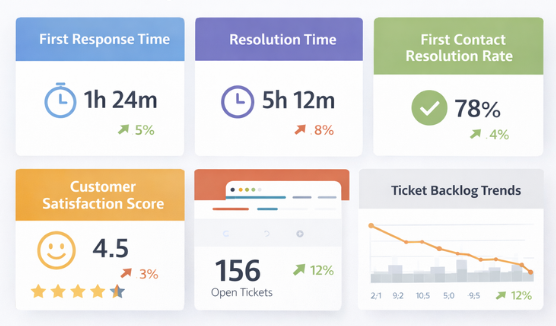
Scalable support requires measurable performance indicators. Decision makers typically monitor:
1. First response time
Measures how quickly a customer receives an initial reply after submitting a query. Shorter response times directly influence customer perception and reduce escalation risk. It also reflects staffing adequacy and workload distribution.
2.Resolution time
Tracks the total time taken to fully resolve a ticket. This metric highlights process efficiency, agent capability, and system bottlenecks. Prolonged resolution cycles often indicate workflow gaps or knowledge deficiencies.
3.First contact resolution rate
Indicates the percentage of issues resolved during the first interaction without follow up. High rates reduce operational cost and improve customer satisfaction. Low rates may signal training gaps or insufficient access to customer data.
4.Customer satisfaction scores
Collected through post resolution surveys, this metric reflects service quality from the customer’s perspective. Consistent tracking helps correlate operational performance with customer sentiment.
5.Ticket backlog trends
Monitors the volume of unresolved tickets over time. A growing backlog suggests capacity constraints or inefficient routing, while a stable or declining backlog indicates operational balance.
Together, these metrics provide visibility into staffing requirements, workflow effectiveness, and recurring product or service issues. Data driven management enables proactive improvements rather than reactive adjustments.
Consistent metric tracking enables proactive decision making, operational forecasting, and continuous service optimization.
6. Integrating with Core Business Systems
Customer support rarely operates in isolation. Integration with CRM, billing, and product systems provides agents with full context during interactions.
Access to order history, subscription status, and prior communications reduces resolution time and improves accuracy and customer satisfaction. System integration prevents duplication of work and ensures consistent customer data across departments.
7. Enabling Agents with Structured Processes
Technology alone does not scale support. Structured onboarding, role based access, and skill based routing ensure queries reach the right agents.
Quality monitoring frameworks and standardized response guidelines maintain consistency across teams. As organizations expand geographically, these controls preserve service standards.
Defined processes and governance controls maintain service quality, support scalability, and reduce variability across distributed teams.
8. Designing for Scalability and Security
Growing businesses require systems that support multi location teams, multi language capabilities, and configurable workflows. Flexibility ensures the support framework evolves with business complexity.
At the same time, customer data must be protected. Role based permissions, activity logs, and secure data handling practices safeguard sensitive information and maintain compliance standards.
Scalable architecture combined with data protection controls ensures long term operational resilience and regulatory compliance as the business expands.
Turning Customer Support into an Operational Asset
Managing customer queries at scale requires structure, automation, and measurable oversight. When executed correctly, support operations provide valuable insights into product quality, operational gaps, and customer sentiment.
As query volume grows, leadership requires visibility beyond daily ticket handling. Consolidated reporting, trend analysis, and performance benchmarking allow decision makers to forecast staffing needs, identify recurring product issues, and refine service policies. When support data is structured and measurable, it becomes an operational intelligence layer that informs broader business strategy rather than functioning solely as a service function.
Solutions such as iScripts SupportDesk provide centralized ticket management, automated routing, self service knowledge bases, and performance analytics within a single platform. For organizations looking to formalize and scale their customer support operations without increasing administrative complexity, structured systems like this help transform support from a cost center into a strategic business function.
