
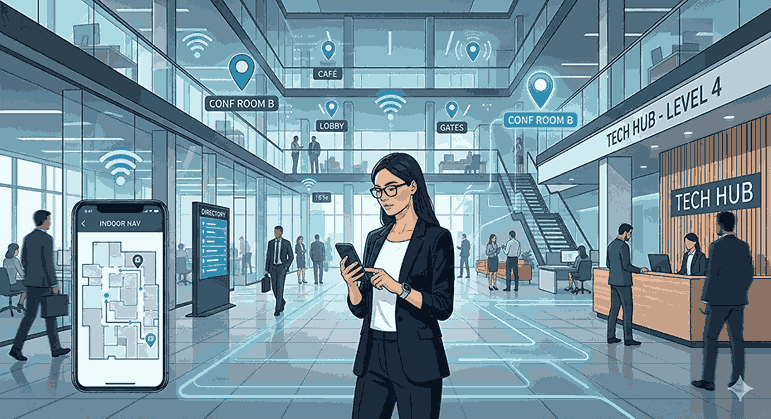
Enterprises have clear visibility across outdoor operations. GPS tracks vehicles, shipments, and deliveries across cities and continents. But once operations move inside buildings, that visibility disappears.
For organizations operating hospitals, warehouses, airports, manufacturing plants, and corporate campuses, this creates a major operational gap. Employees spend time locating equipment, visitors struggle to navigate large facilities, and assets move without clear tracking.
Indoor Positioning Systems address this challenge by bringing location intelligence into indoor environments. For enterprises managing complex facilities, the ability to track people, assets, and movement inside buildings is becoming a critical operational capability.
The Indoor Visibility Gap in Enterprise Operations
Large facilities are designed to support thousands of interactions every day. Equipment moves across departments, employees coordinate tasks across floors, and visitors try to find their way through unfamiliar environments.
Without indoor location data, enterprises operate with limited visibility.
Staff often spend valuable time searching for equipment or inventory.
Visitors may struggle to locate departments, meeting rooms, or service areas.
Operational delays occur when teams cannot quickly identify where resources are located.
Asset movement becomes difficult to track in real time.
These challenges become more severe as facilities grow larger and operations become more complex. Indoor positioning systems help close this visibility gap by providing accurate location data within buildings.
What Is an Indoor Positioning System
An Indoor Positioning System determines the real time location of people, equipment, and assets inside buildings using wireless signals and sensors.
Unlike GPS, which relies on satellites, indoor positioning systems use local technologies such as Bluetooth signals, wireless networks, or tracking tags to estimate location within a building.
Common Indoor Positioning Technologies

Many enterprise deployments combine multiple technologies depending on the building structure and the level of accuracy required. Indoor positioning systems provide the foundation for indoor navigation, asset tracking, and location based operational insights.
Why Indoor Location Intelligence Matters for Enterprises
1. Operational Efficiency
Real time location data allows organizations to track assets and equipment across large facilities.
In warehousing environments, location intelligence can guide workers directly to the correct inventory location. This reduces picking time and improves order accuracy.
When location data integrates with operational software systems, organizations gain better visibility into workflows and resource allocation.
2. Asset Utilization
Enterprises invest heavily in equipment and mobile assets. When these resources cannot be located quickly, productivity suffers.
Hospitals provide a clear example. Medical equipment frequently moves between departments throughout the day. Without tracking systems, staff may spend significant time locating devices.
Hospitals that implement indoor positioning systems often reduce the time required to locate equipment and improve overall staff efficiency.
3. Workforce Productivity
Location awareness allows organizations to coordinate teams more effectively.
Manufacturing facilities can track tools and equipment across production floors. Logistics teams can identify the nearest available resources when tasks need to be completed.
When employees spend less time searching for resources, productivity improves naturally.
4. Visitor and Customer Navigation
Large buildings can be difficult to navigate for first time visitors.
Hospitals, airports, and corporate campuses often contain multiple floors, departments, and service areas. Without clear guidance, visitors frequently rely on staff assistance.
Indoor positioning systems enable digital navigation that guides people through complex environments, improving visitor experience while reducing staff workload.
Enterprise Use Cases Across Industries
- Indoor positioning systems are being adopted across a wide range of industries where operational visibility is critical.
- Healthcare organizations use indoor positioning to track medical equipment and improve patient navigation.
- Logistics and warehousing companies use location tracking to optimize inventory movement and streamline fulfillment processes.
- Manufacturing facilities monitor equipment and production assets to improve operational coordination.
- Airports and transportation hubs help passengers navigate terminals and locate services more efficiently.
- Corporate campuses and large office environments use indoor navigation tools to assist employees and visitors.
- Across these sectors, location intelligence is becoming a fundamental component of modern facility management.
Market Growth and Enterprise Investment
The market for indoor positioning technologies is expanding rapidly as enterprises invest in connected facilities and smart building infrastructure. Industry research estimates that the global indoor positioning and navigation market was valued at more than 30 billion dollars in the mid 2020s and is expected to exceed 130 billion dollars by the end of the decade. This growth reflects strong demand for real time location intelligence across healthcare, logistics, retail, and corporate environments.
Advances in wireless technologies such as Bluetooth Low Energy, ultra wideband sensors, and improved wireless networks have made indoor positioning more accurate and more scalable for enterprise use. At the same time, organizations are increasingly integrating indoor location data with analytics platforms, operational software systems, and smart building infrastructure.
For enterprises managing large facilities, indoor positioning is evolving from a specialized technology into a strategic operational capability.
From Indoor Positioning to Indoor Navigation
Location data alone does not solve operational challenges. Enterprises also need systems that translate this data into clear and usable navigation tools. Indoor navigation platforms use digital maps, routing algorithms, and facility data to guide users through complex environments.
Employees can quickly locate resources within buildings. Visitors can find departments and meeting rooms without assistance. Organizations gain better control over how people move through their facilities.
This combination of indoor positioning and navigation systems helps enterprises transform raw location data into practical operational value.
Bringing Visibility Inside Enterprise Facilities
Enterprises operating large indoor environments face a common challenge. Once operations move inside buildings, visibility becomes limited. Equipment is harder to locate, staff spend time searching for resources, and visitors struggle to navigate complex facilities. Indoor positioning systems address this gap by bringing location intelligence into indoor environments. When combined with digital navigation tools, they enable organizations to improve operational efficiency, asset utilization, and user experience.
Businesses exploring indoor navigation and mapping solutions can also consider platforms like iScripts WayFinder which allows organizations to build interactive indoor maps and wayfinding systems that help employees and visitors navigate large facilities more effectively.