
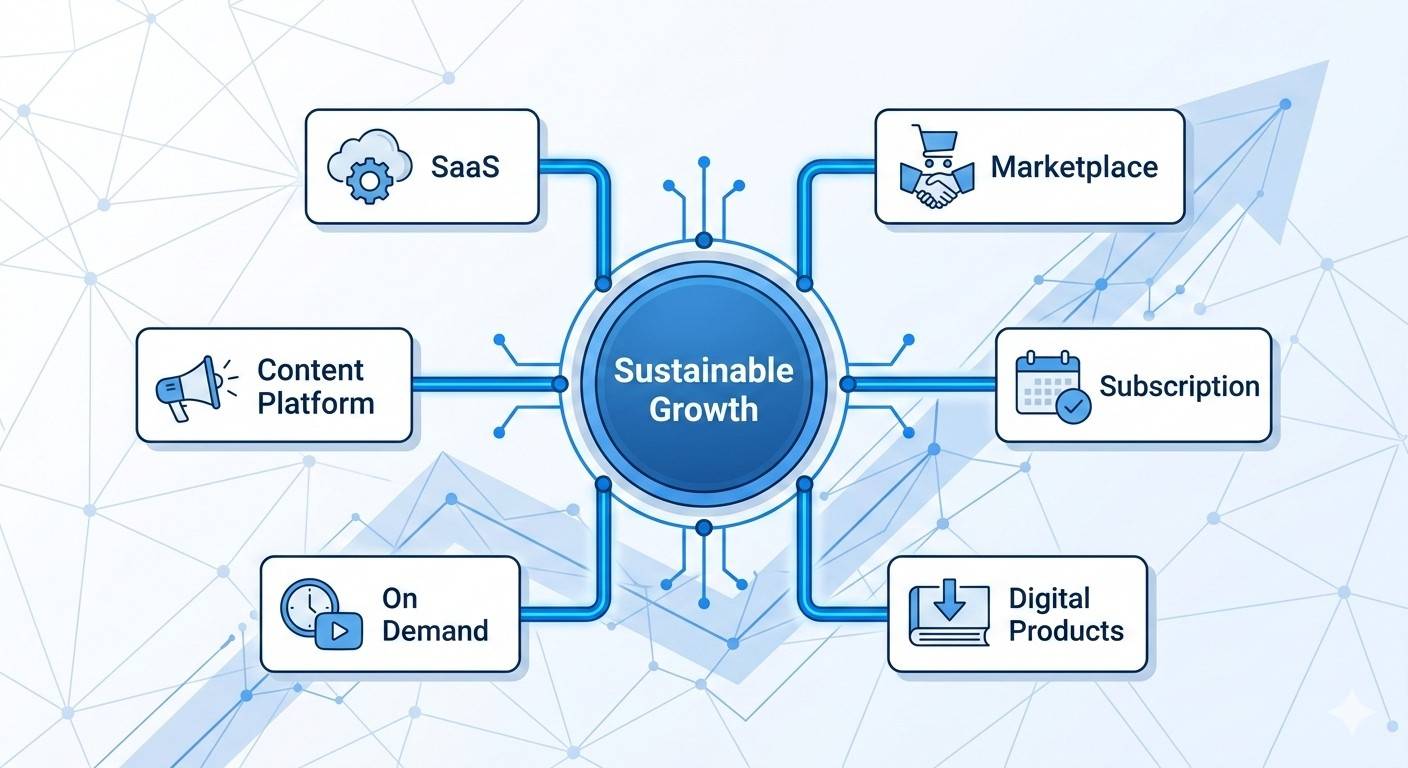
Online Business Models With Sustainable Growth Potential
The internet has lowered barriers to entry for entrepreneurs. However, accessibility does not guarantee sustainability. Thousands of online businesses launch every year, yet only a fraction achieve consistent profitability and long term growth.
Success in the digital economy is not driven by trend selection alone. It is driven by business model structure, revenue predictability, scalability, and disciplined execution.
This guide analyzes online business models with strong structural advantages, explains why many online ventures fail, and helps founders evaluate which model aligns with their capabilities and market conditions.
Why Most Online Businesses Fail
Before evaluating strong online business models, it is critical to understand common failure patterns.
Most online ventures collapse due to:
-
Weak unit economics
-
High customer acquisition costs
-
No recurring revenue stream
-
Low product differentiation
-
Poor operational scalability
Many founders prioritize product launch, branding, or website design while ignoring financial architecture. Without disciplined planning around margins, retention, and customer lifetime value, even high traffic platforms struggle to convert growth into sustainable profit.
Structural Weakness Hidden by Early Growth
Early traction can conceal long term instability. Heavy discounts, paid ads, and promotional offers may inflate user acquisition, but if retention is weak, revenue must constantly be replaced with new marketing spend. This creates a cycle of dependency on advertising capital.
Pricing Misalignment
Underpricing erodes margin. Overpricing reduces conversion. Sustainable online business models align pricing with delivered value, competitive positioning, and long term profitability targets.
Operational Complexity
As transaction volume increases, support, infrastructure, logistics, compliance, and vendor management costs expand. Without scalable systems, cost growth matches or exceeds revenue growth, eliminating operating leverage.
The business model determines survivability more than the idea itself.
Characteristics of Structurally Strong Online Business Models
Online business models with long term growth potential share measurable traits.
-
Recurring or repeat revenue
-
Low marginal cost of delivery
-
Scalable infrastructure
-
High customer lifetime value
-
Switching friction or ecosystem lock in
-
Data driven optimization capability
Revenue Predictability
Subscription billing, recurring contracts, or habitual repurchase behavior allows reliable forecasting. Predictable revenue improves capital allocation and reduces acquisition dependency.
Margin Expansion
Strong online models benefit from operating leverage. As user volume grows, cost per transaction declines relative to revenue, improving gross and operating margins.
Competitive Defensibility
Network effects, workflow integration, proprietary data, and ecosystem development create switching friction. Businesses that embed themselves into customer processes reduce churn and increase lifetime value.
High Probability Online Business Models Explained
Below are the most structurally resilient online business models when executed properly.
1. Software as a Service (SaaS)
Revenue Model
Subscription based recurring revenue, typically monthly or annual billing.
Margin Profile
High gross margins, often between 70 and 90 percent after development costs.
Strengths
-
Recurring predictable revenue
-
High scalability
-
Strong retention potential
-
Low distribution cost
Risks
-
High initial development cost
-
Competitive saturation
-
Dependence on retention and churn management
SaaS businesses succeed when they solve mission critical problems and integrate deeply into workflows.
2. Online Marketplace Model
A marketplace connects buyers and sellers while taking a commission per transaction.
Revenue Model
Commission percentage, listing fees, subscription tiers, or advertising.
Strengths
-
Asset light structure
-
Network effects
-
Scalable transaction volume
Risks
-
Liquidity challenge in early stage
-
Two sided user acquisition complexity
-
Trust and quality control management
Marketplaces become powerful when supply and demand reinforce each other.
3. Subscription Commerce
This model delivers physical or digital products on a recurring schedule.
Revenue Model
Monthly or annual subscription billing.
Strengths
-
Predictable cash flow
-
Customer retention through convenience
-
Strong forecasting ability
Risks
-
Inventory management complexity
-
Churn sensitivity
-
Logistics and fulfillment costs
Success depends heavily on retention, personalization, and operational efficiency.
4. Digital Product Business
Includes online courses, templates, media, ebooks, and downloadable tools.
Revenue Model
One time purchase or tiered access pricing.
Strengths
-
Extremely low marginal cost
-
High gross margins
-
Global reach
Risks
-
Marketing dependency
-
Low entry barriers
-
Intellectual property vulnerability
This model thrives with strong brand authority and audience trust.
5. On Demand Service Platform
Connects customers with service providers in real time.
Revenue Model
Commission per transaction or service fee markup.
Strengths
-
Transaction scalability
-
Geographic expansion potential
-
Repeat usage potential
Risks
-
Operational coordination
-
Provider quality management
-
Regulatory complexity
Operational discipline and platform reliability determine long term viability.
6. Content and Advertising Platform
Content driven websites monetized through ads, sponsorships, or affiliate marketing.
Revenue Model
Advertising revenue, affiliate commissions, sponsorship deals.
Strengths
-
Low infrastructure cost
-
Global reach
-
Scalable traffic monetization
Risks
-
Platform algorithm dependency
-
Traffic volatility
-
Revenue instability
This model requires diversified traffic channels and authority positioning.
Comparison of Online Business Models
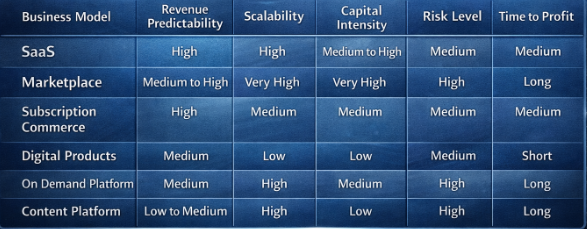
Comparison of Online Business Models
Choosing the Right Online Business Model
Selecting the best online business model depends on:
-
Available capital
-
Technical capabilities
-
Operational expertise
-
Risk tolerance
-
Target market maturity
-
Customer acquisition strategy
Founders should evaluate whether they can manage recurring billing, marketplace liquidity, logistics operations, or software maintenance before committing to a model.
Sustainable growth emerges from alignment between structure and capability.
Building Scalable Infrastructure for Long Term Growth
An online business model is only as strong as the technology supporting it. Scalability, automation, and recurring revenue management require robust infrastructure.
iScripts provides ready to deploy platforms for:
-
Online marketplaces
-
Ecommerce systems
-
Subscription commerce
-
On demand service platforms
With customizable and scalable solutions, iScripts enables entrepreneurs to launch faster while maintaining operational flexibility. Instead of rebuilding core systems from scratch, founders can focus on strategy, customer acquisition, and market differentiation.
The right business model improves probability.
The right infrastructure accelerates execution.
Structure Determines Sustainability
Online entrepreneurship rewards innovation, but it punishes structural weakness.
Business models with recurring revenue, scalable cost structures, and defensible positioning consistently outperform trend driven ventures.
There is no model that always succeeds.
There are models with stronger economic foundations.
Long term success depends on selecting the right structure, executing with discipline, and building on technology designed for scale.

