
Imagine you are a founder with a clear goal to help people create websites without writing code. That is what a website builder business is all about. It offers ready to use tools, templates, and editors that allow users to design, publish, and manage their own websites easily.
Even though the product feels simple to users, an important decision sits behind it. The technology you choose affects how much money you spend, how fast you can launch, and how easily your platform can grow when more users join. It also decides how flexible your product will be when users ask for new features.
At this stage, founders usually choose between two options. One is custom development, where everything is built specially for your idea. The other is a turnkey platform, which is a ready solution you can start using quickly. Both have their pros and cons. There is no perfect choice for everyone. This guide helps founders understand both options and choose what suits their goals, budget, and future plans.
2. Understanding Custom Development for Website Builders
What Is Custom Development?
Custom development refers to building a website builder platform that is tailored to your business needs. The platform is developed from scratch or through semi custom development using modern frameworks. This approach gives you full control over how your website builder software works. You can design the features, the user experiences, the backend infrastructure and all integrations based on your requirements. Custom development can be done by an in-house development team or through outsourced custom development services. The goal is to create a scalable and flexible website builder solution that supports long term growth.
Advantages of Custom Development
Limitations of Custom Development
2. Understanding Turnkey Website Builder Platforms
What Are Turnkey Platforms?
Turnkey platforms are pre-built website builder solutions that are ready to launch with minimal setup. These platforms come with essential website builder features already included. This usually covers template drag and drop editors hosting and basic integrations. Turnkey solutions are designed to help founders start a website builder business quickly without building everything from scratch. Common examples include white label website builders and SaaS website builder kits that can be branded and launched in a short time.
Advantages of Turnkey Platforms
-
Faster time to market with ready-to-use builder
-
Lower initial investment than custom development
-
Minimal technical complexity for non-technical founders
-
Suitable for MVPs and quick market validation
Limitations of Turnkey Platforms
- Limited feature and UI customization
- Dependent on vendor updates and platform changes
- Scalability constraints as user base grows
- Restricted ability to add advanced or custom features
- Limited ownership of code and intellectual property
3. Custom Development vs. Turnkey Platforms: Key Comparison Areas
| CUSTOM DEVELOPMENT | TURNKEY PLATFORMS |
| Higher upfront cost with long term control | Lower initial cost with recurring fees |
| Slower launch due to development | May face scaling limitations |
| Built to scale as users grow | Limited or vendor-controlled integrations |
| Full ownership with complete control over security and data | Limited ownership and vendor dependency |
| Full control over features and design | Limited performance tuning |
| Flexible third party integrations | Largely managed by vendor |
| Fast launch with ready-made setup | |
| Limited customization options |
4. Which Option Is Best for Your Website Builder Business?
When Custom Development Makes Sense :
When you want to create a website builder that is genuinely distinctive, custom development makes sense. A custom approach offers you the freedom you require if your product idea goes beyond basic features or targets a particular market. It is also a better choice if you want your platform to grow as more people sign up and you expect long-term growth. Custom development is most effective when you have a strong technical team or a reliable development partner who can manage the complexity and maintain the platform over time.
When Turnkey Platforms Are the Better Choice :
Turnkey systems are a great option if speed and usability are your top priorities. If you want to launch quickly without spending a lot of time or money on development, a ready-made solution can help you get started more quickly. This strategy is also appropriate if you lack technical resources or have a tight budget. When conventional website builder capabilities are sufficient to assess the market, many founders use turnkey platforms to test a business idea or create an MVP.
5. A Hybrid Approach: Starting Turnkey, Scaling with Custom Development
Many founders choose a hybrid strategy that combines both turnkey platforms and custom development. In the early stages, using a turnkey platform helps validate the market quickly. It allows you to launch faster, test your idea, and understand what users actually need without spending heavily on development. This stage is helpful for gathering feedback and confirming demand.
As the business grows, founders often start adding custom features. They may keep the core platform but build custom tools or integrations to improve the user experience. Over time, this can lead to a more flexible and unique product that better supports growth.
The hybrid model has clear advantages and a few challenges. It reduces early risk and cost while still allowing room for customization later. However, it can also increase complexity, especially when mixing vendor systems with custom code. The transition usually makes sense when user growth increases or when platform limitations start slowing progress. At that point, founders can gradually move parts of the product to custom development, either feature by feature or through a planned rebuild, based on business needs and long term goals.
6. Making the Right Choice for Sustainable Growth
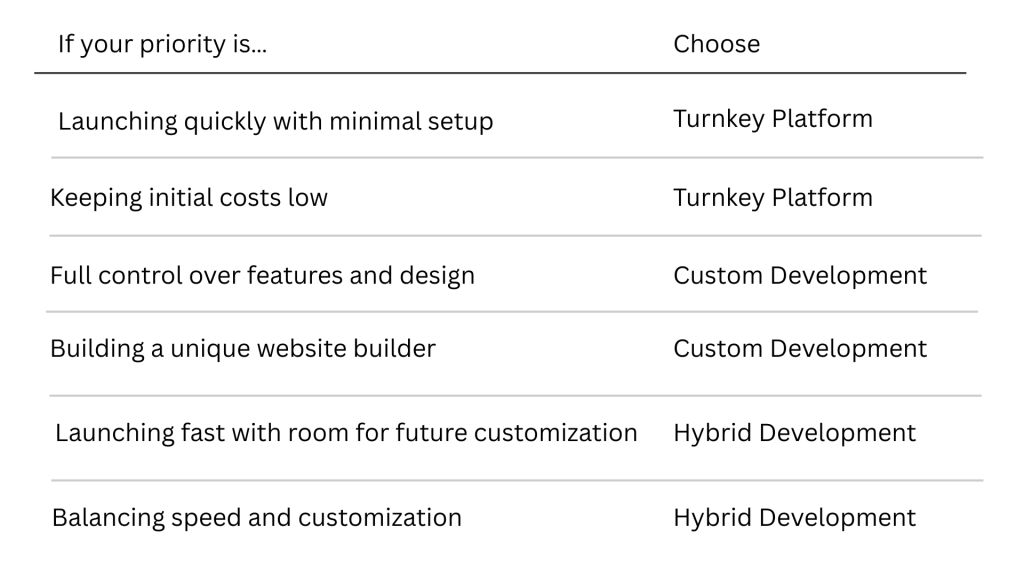
There isn’t a single solution that suits all website builders. Every founder has unique objectives, financial plans, and expansion strategies. Because of this, the best option will depend on what you want to develop and how you want your company to expand over time.
Turnkey platforms are an excellent option if you want to start out quickly and with little initial investment. When you desire complete control and intend to expand the product over time, custom development is more effective. Depending on your circumstances, both choices may be helpful.
Spend some time considering your options rather than making a quick selection. You can choose the solution that best meets the demands of your business today and in the future by creating a comprehensive plan.
Not sure which path is right for your website builder business? You don’t have to decide alone.
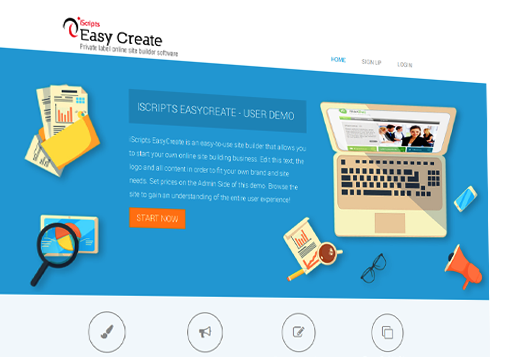
If you want to launch quickly with a ready-made solution, Easycreate is a powerful turnkey platform that helps you go live fast with minimal setup and lower upfront effort.
If you’re planning to build a fully custom website builder, need advanced features, or want complete control over your platform, iScripts offers custom development tailored to your business goals.
Choosing the right foundation today can save time, cost, and rework tomorrow.
